
AetherC2 - "Yad2 Delivery" Android Attack-Chain Analysis
A four-stage Android banking trojan delivered to Israeli Yad2 sellers as a fake delivery app. We recovered the operator's mTLS certificates from the sample and watched a live botnet of 44 victims read-only: SMS and OTP theft, a live keylogger, covert remote control, and a SOCKS5 proxy that routes bank fraud through the victim's own phone.
[REDACTED]. All intelligence was collected passively, read-only. No command was ever sent to any victim device.The malware reaches Israeli Yad2 sellers as a fake "delivery/courier" app. It is a four-stage packed banking trojan - AetherC2 - operated over MQTT at ssl://194.5.97.27:443 with mutual TLS.
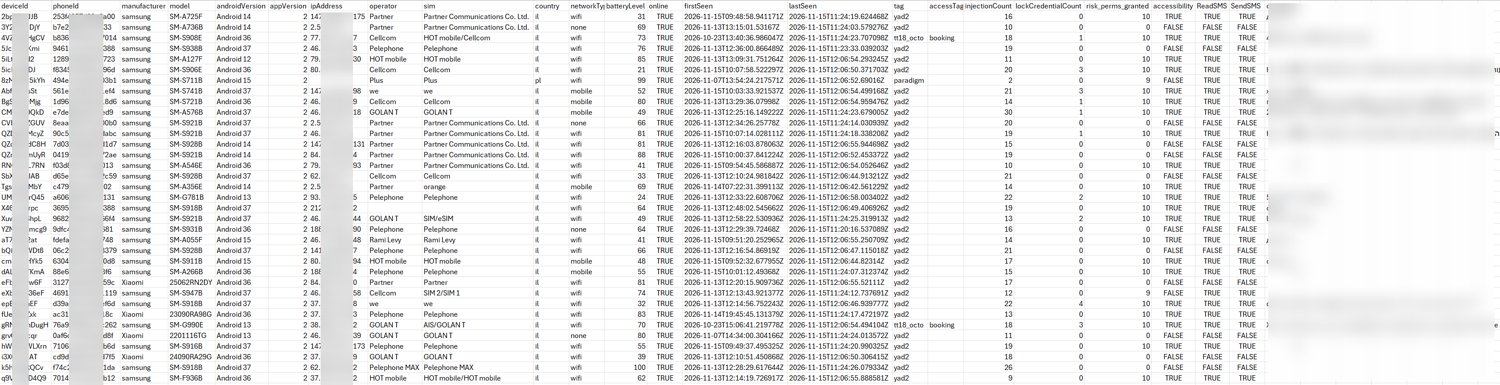
Using certificates and credentials extracted statically from the sample, passive read access to the command server confirmed a live botnet of 44 Israeli victims with SMS and OTP theft, a live keylogger, covert remote control, web-inject, and an exposed operator-panel feed whose notes are written in Russian. Campaign tag: yad2.
How the attack works
The short version, before the technical detail.
- The lure. A scammer sends the seller a fake "a buyer was found for your item" message impersonating Yad2, with a link to a counterfeit app-store page.
- The fake update. The app looks normal, then shows a fake "Google Play Services update" screen that pressures the victim into granting powerful permissions - Accessibility above all.
- The hidden install. Behind the decoy it quietly unpacks and installs the real banking trojan in several hidden layers, so scanners see only a harmless-looking app.
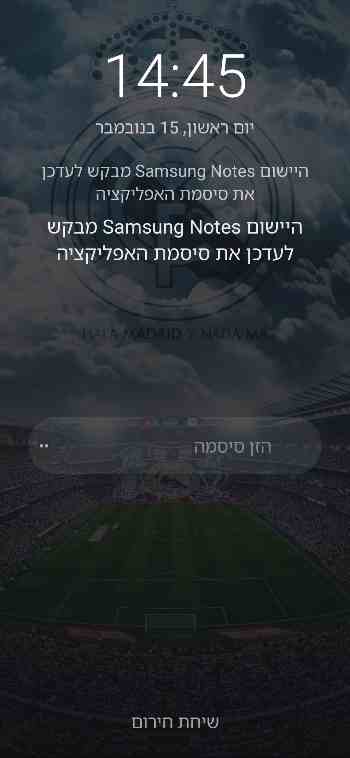
- The takeover. The trojan connects to the attacker's server and can now read SMS and one-time codes, record keystrokes, and watch and control the screen invisibly.
- The fraud. A Russian-speaking operator opens the banking app on the victim's own phone, uses the stolen SMS codes to pass two-factor authentication, and empties the account.
Initial access - the phishing lure
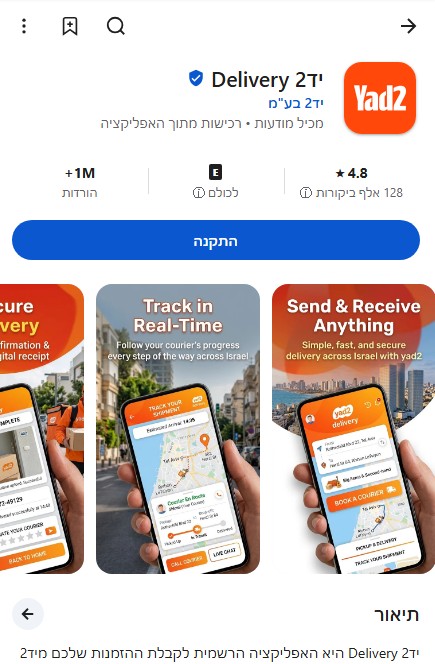
The seller receives an SMS claiming an item has been bought and that a separate "YAD2 Delivery" app is needed to confirm the order. The link - https://yad2appl.org/app-download - opens a page crafted to look like a Google Play listing: verified badge, 4.8 stars, a million downloads, 128,000 reviews. Tapping Install sideloads the APK.
Infection and unpacking chain
| Stage | What it is | Crypto | Mechanism |
|---|---|---|---|
| 1 | APK (decoy) | — | React-Native UI plus the loader Hhopetomato |
| 1 → 2 | Dropper | RC4 | Reads a junk-path asset ending dspePLn.otf, decrypts, unzips, injects the DEX and swaps the live Application through ActivityThread reflection |
| 2 → 3 | Packer | AES-256-GCM | Stage 3 is appended to assets/banner_48222095.bin behind a fake WEBP header. Trailer is a length at len-6 plus magic 0xAE7D; the key lives in TokenMap as Base64 then XOR. Installed silently with SessionPackageInstaller |
| 3 → 4 | Trojan | RC4 | Same loader technique from asset DPSlSR.html. The native libraries libyaan7ldva.so and libztx033yop.so ship inside the stage-3 APK |
Anti-analysis runs throughout: a malformed ZIP, deliberately wrong CRCs, a fake "encrypted" flag, a STORED manifest whose compressed size is smaller than its uncompressed size, zero padding, and a decoy DEX.
Command-and-control architecture
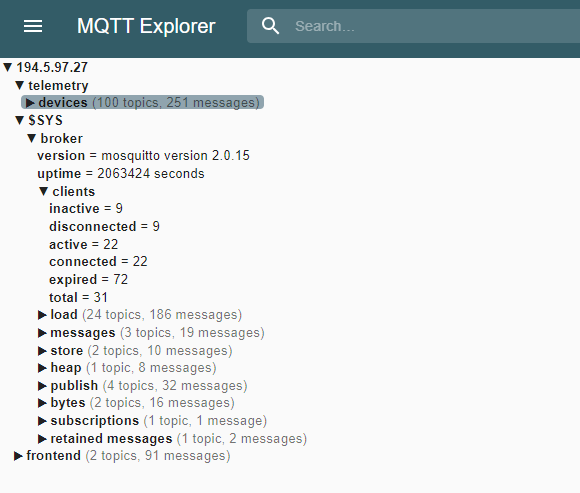
The broker is Mosquitto 2.0.15 on 194.5.97.27:443, protected by mutual TLS - and by an access control list that is wide open to anyone holding the client certificate shipped inside the malware. Each device is addressed by a ten-character token derived from a hash of its hardware fingerprint.
| Topic | Direction | Purpose |
|---|---|---|
telemetry/devices/{id}/health | bot → C2 | Online/offline status, retained |
telemetry/devices/{id}/reports | bot → C2 | Stolen data. Contacts and SMS are encrypted with the malware's own cipher; keystrokes are sent in the clear |
telemetry/devices/{id}/stream | bot → C2 | Covert screen stream and accessibility tree |
telemetry/devices/{id}/signals | C2 → bot | Operator commands to the device |
frontend/updates | C2 → panel | The operator panel's event feed, in the clear |
Capabilities, confirmed live
| Capability | Detail |
|---|---|
| SMS and OTP theft | Read, send and hide SMS. Interception of one-time codes defeats two-factor authentication |
| Live keylogger | Real-time keystrokes - observed in WhatsApp, in Hebrew |
| Covert remote control | Live screen stream plus the accessibility tree, so the operator can drive the phone invisibly |
| Web-inject | Fake overlays drawn on top of banking apps |
| Spying | Camera, microphone, location, contacts, call log, accounts |
| SOCKS5 proxy | Fraud routed out through the victim's own mobile IP address |
| Resilience | Anti-uninstall, a watchdog, and automatic granting of Accessibility |
What the stolen data looks like
The structures below are real. Every value that could identify a person has been replaced.
Beacon — in the clear
{"type":"ping","data":{"scr":"2","BC":"f","BP":"81",
  "permissions":{"accessibility":true,"ReadSMS":true,"SendSMS":true,
    "ReadContacts":true,"Camera":true,"RecordAudio":true,"Location":true,
    "Ant_delet":true,"HideSMS":false,"DefaultSmsApp":false}}}
Keystrokes — in the clear
{"type":"keys","data":{"data":
  "[12:04|com.whatsapp][REDACTED — Hebrew WhatsApp message][/com.whatsapp]"}}
SMS - encrypted on the wire, trivially decrypted
// on the wire:
{"type":"sms","data":"R2x1a0Zq9W... (ciphertext)"}

// after decryption — the stolen inbox, including bank one-time codes:
{"data":"[REDACTED sender] | [REDACTED — message body / one-time code] | 2026-11-15T.."}
The victim profile, as the operator sees it
{"type":"device_update","device":{
  "deviceId":"[REDACTED]","phoneId":"[ANDROID_ID]",
  "manufacturer":"samsung","model":"SM-G990E","androidVersion":"Android 13",
  "ipAddress":"[REDACTED]","operator":"[carrier]","country":"il",
  "online":true,"injectionCount":18,"lockCredentialCount":3,
  "tag":"yad2","accessTag":"booking",
  "comment":"[REDACTED — Russian operator notes: screen PIN, credentials, bank-auth status]"
}}
The proxy - fraud from the victim's own address
A status message on the command channel confirms a live SOCKS5 back-connect proxy. The infected phone dials out to the operator's relay, traversing carrier NAT, and the relay exposes a per-victim listener.
{"type":"Socks5","cuz":"U","running":true,"connected":false,
 "username":"[REDACTED]","password":"[REDACTED]"}
Combined with covert screen control on the same device fingerprint and with stolen one-time codes, this makes a bank login originate from the victim's real device and their real IP address. The customer's entire trust context is reproduced, so geolocation, IP reputation, device binding and geo-velocity checks never fire. This is the part that should worry a fraud team most.
Covert remote control
- Live screen pixels - a downscaled image of roughly 25 KB per frame, streamed continuously
- The accessibility tree - every on-screen element with its text, its coordinates and whether it is clickable
- Remote actuation - the operator taps any element by its coordinates, and so drives banking apps on the victim's own phone
The operator's command vocabulary
Across 14,928 command events on 34 devices over roughly ten hours, the complete observed vocabulary was remarkably small. Almost all traffic is an automated maintenance loop; the hands-on fraud commands surface only during a live session.
| Signal | Count | Devices | Meaning |
|---|---|---|---|
wrk · Apps·R·org.ypcsjwn.ldvhvd | 7,321 | 30 | Uninstall a named package |
wrk · Delete | 7,316 | 30 | Trigger the uninstall and cleanup flow |
com · sync | 282 | 31 | Hourly inject-sync heartbeat |
screen · Screen | 1 | 1 | Start the covert screen stream |
NET_PING | 4 | 1 | Round-trip latency probe during live control |
STOP_DIAGNOSTICS_STREAM | 4 | 1 | Stop the stream |
The bot's own debug log shows every command routed through a modular dispatcher with eight registered handlers - Files, Camera, SMS, Activitys, Socks5, Permissions, Apps and Delete. That registry is the bot's full command surface. In this capture only three were exercised; the rest exist and were simply not used in the window.
One captured live session
On a single device we captured a complete operator screen-control session, start to stop, in about nine seconds.
20:29:43Z   screen   start stream   quality=28 width=280 fps=15   viewer_id=0ac958ad-…
20:29:43-49 NET_PING x4            latency probes during control
20:29:51-52 STOP_DIAGNOSTICS_STREAM  param_text="vnc" then "hvnc"   (same viewer_id)
The viewer_id identifies the operator's own console session - an attribution artefact that can link multiple devices and multiple sessions back to one operator.
The encryption is reversible
out[i] = in[i] ^ ((3*i + K) & 0xFF) ^ TABLE[(K+i) % 32] ^ TABLE[(K+5*i) % 32]

TABLE = 7a3ca15e…5ca23e      K = 42      decrypt == encrypt
The device identifier is equally recoverable: a SHA-256 of the hardware fingerprint, reduced by a 32-bit hash and encoded into a ten-character alphabet with the ambiguous characters removed.
Attribution and scope
The operators are Russian-speaking - the profile comment field is Cyrillic and carries manual fraud notes. We observed 44 unique victims, 26 of them fully compromised, almost all Israeli across every major carrier, plus two in Poland. Campaign tags seen: yad2, tt18_octo, paradigm.
Indicators of compromise
| Type | Value |
|---|---|
| APK SHA-256 | 315d2e6acfbf1f745c53100b8909d5e7981c30a81e8ca2653036a55f937c7069 |
| Signer SHA-256 | 492682f877607ee99df2ddd2bd5953fd727bdf6e19d397de9dbbafd582bcad75 |
| Packages | io.desk.crane.Hhopetomato · iacq.nom5w5vl.ucq58.* · org.ypcsjwn.ldvhvd |
| Native libraries | libyaan7ldva.so · libztx033yop.so |
| Command server | 194.5.97.27:443 — Mosquitto 2.0.15 over TLS |
| mTLS root | CN=AetherC2 Root CA · SHA-256 86266124958fae14046795179e8ca0ad94e1870f8b6b5cc2021d65d4207c24a2 |
| Distribution URL | https://yad2appl.org/app-download — fake Play page serving the APK |
| Operator session | viewer_id 0ac958ad-… — console session identifier, useful for attribution |
Detection and mitigation
- Phishing. Block
yad2appl.org. It exists only to serve a fake Play page that sideloads the APK. - Network. Block
194.5.97.27:443, and alert on outbound MQTT-over-TLS to a bare IP on 443 with no SNI from Android devices. - Endpoint. Flag any app that requests Accessibility and forty-plus permissions straight after a "Google Play update" screen, uses a silent session installer, or starts a local VPN service.
- Fraud. Treat an Android device acting as a SOCKS5 exit node as a banking-fraud indicator, not merely a malware artefact. Alert on long-lived outbound tunnels, and flag sessions whose IP address and device both match the customer but whose behaviour does not.
- Users. Never sideload a "delivery app" sent as a link after listing an item. Install from Google Play or not at all.
Key terms
| Term | What it means |
|---|---|
| Command server (C2) | The attacker's server that infected phones connect to for orders and to upload stolen data |
| MQTT | A lightweight messaging protocol — a chat bus. Here it is the command channel, hidden inside TLS on port 443 |
| Covert remote control | Secret screen control: the attacker sees and taps the screen without the victim noticing |
| One-time code / 2FA | The code a bank sends by SMS. Stealing it defeats two-factor authentication |
| Keylogger | Records everything the victim types, including passwords and messages |
| Web-inject / overlay | A fake screen drawn on top of a real banking app to capture login details |
| Accessibility abuse | An Android feature built for users with disabilities, abused to auto-tap, read the screen and grant permissions |
| Mutual TLS | Both sides prove identity with certificates. The app carries the attacker's client certificate — which is how we got read access |
| Malware-as-a-Service | The kit is rented to operators, who each run their own victim campaigns |
Found something that affects you, or want this checked against your own estate? Reach us at info@cyberapp.co.il.